
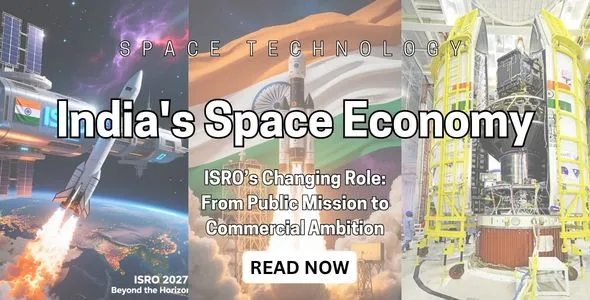
India’s space program is going through a tremendous change. The Indian Space Research Organization (ISRO), which has traditionally been responsible for creating, building, and producing India’s space vehicles, is rapidly shifting beyond ordinary rocket manufacture and delegating more responsibility to commercial business and public sector entities.
ISRO’s Changing Role: From Public Mission to Commercial Ambition
IN-SPACe Chairman Pawan Goenka recently underlined this change, stating that ISRO will cease to solely concentrate on producing launching vehicles, with that task shifting progressively to private firms and government-sponsored entities. The goal is to enable ISRO to focus on studies, cutting-edge technologies, and experimental operations. This is a component of a bigger overhaul of India’s space sector that commenced with the introduction of the satellite-sector reforms in 2020.
At first look, this might look to represent a straightforward organizational or monetary choice. However, it poses a far bigger question: What will happen to a scientific organization if manufacturing, technological advancements, and operational endeavors grow progressively integrated into a privately owned and commercial network?
From Public Manufacturing to Private Sector Participation
At first look, this might look to represent a straightforward organizational or monetary choice. However, it poses a far bigger question: What will happen to a scientific organization if manufacturing, technological advancements, and operational endeavors grow progressively integrated into a privately owned and commercial network?
This does not suggest that ISRO is developing into a commercial entity. Rather, it indicates that ISRO is now progressively operating within a commercial technology framework.
This is an essential difference.
The Benefits and Challenges of Commercialisation
The private sector adds money, competitiveness, quicker production, and the chance to make innovations bigger more swiftly. The nation’s expanding satellite sector is also able to help the country become more competitive in the international space sector and generate fresh jobs. ISRO has said that involvement from the sector may assist to fulfill the growing need for start-up service offerings. In its yearly report, NSIL says it has signed a deal with company partners led by HAL to make five PSLV-XL vehicles from start to finish. At the same time, Indian industry is making 15 SSLVs.
But the rise in individualism impacts how authority works as well. When technical equipment is used in a business setting that is profitable, issues of speed, proprietary rights, owning information, funding, and making money get more significant.
Artificial Intelligence, Data, and the Changing Nature of Space Technology
This is when machine learning and digital innovations play a major part.
Data is a key component of today’s space programs. Large volumes of data are constantly produced by spacecraft, and machine learning is becoming more and more useful for analyzing telescopic pictures, spotting trends, anticipating malfunctions, improving efficiency, and aiding in making choices. AI can transform into a leadership and organizational device in addition to a technical instrument when additional space operations enter a privatized environment.
As an outcome, human employees may be progressively assisted—or assessed—by algorithmic and computerized procedures in a novel form of technical judgment.
Who Owns Technology? Public Investment and Private Interests
This returns us to a question that is frequently asked about modern firms: Who owns the technology itself, and who is impacted by it?
A rocket manufactured by a commercial enterprise is not necessarily problematic. In actuality, cooperation between the public and commercial sectors can improve the nation’s technological skills. The issue arises when concerns about public responsibility take a backseat to efficiency in technology as the main indicator of progress.
The Changing Nature of Scientific Labour
There is a labor component as well. The kind of labor may alter as manufacturing moves from government agencies to private businesses. Production processes could grow increasingly machined, driven by results, and specialized. Availability, manufacturing monitoring, fault detection, and job optimization may all be progressively determined by systems based on artificial intelligence. Therefore, innovation has the power to change not just whatever is generated but additionally how individuals perform.
For this reason, privatization does not constitute the sole way to understand the ISRO transformation. The vocabulary of scientific strength must also be used to analyze it.
Accountability, Data Security, and the Future of India’s Space Sector
The issue is not about if private businesses ought to take a role in the Indian airspace initiative. They certainly do, and it may be beneficial for them to participate. How this fresh ecology can be controlled is a particularly crucial concern.
India will need to build robust systems for accountability, ensuring data security, technical openness, and ethical utilization of AI if ISRO is progressively in charge of scholarly and sophisticated scientific initiatives whereas businesses produce and market existing technology.
Beyond Commercial Success: Protecting the Public Purpose of ISRO
Thus, the foreseeable future of India’s space endeavor might involve more than just the transfer of missiles from public to private manufacturers. It might be a tale of a whole technology organization undergoing change.
The notion that scientific understanding can fulfill a broader societal objective constituted the foundation of ISRO’s achievement. Making sure that technical advancement is not made a sign of company productivity alone would be a problem as India reaches a more profitable space era.
Therefore, the true question for India’s future space economy is not public or private?
It is: How can India develop a highly sophisticated and profitable space industry while not sacrificing focus on the public goal that initially enabled the Indian space program?
Frequently Asked Questions (FAQs)
-
How is ISRO’s function in India’s aerospace industry evolving?
India’s main space explorations and scientific investigations are still led by ISRO. At a comparable time, privately owned companies are being encouraged by government officials to produce standard telecommunications equipment, create standardized space technology, and offer commercial services of the highest quality.
-
How may individual companies support the expansion of India’s space sector?
The space industry can benefit from fresh concepts, capital, and rivalry between established companies. They can create conventional launching vehicles, telecommunications satellites, and additional technology, which will increase the field’s business opportunities.
-
Why is the expansion of India’s space economy important?
An expanding space economy has the potential to boost scientific inquiry, increase communication standards, generate employment opportunities, and offer services like predicting the weather. Additionally, it can increase India’s proficiency in technology and power in the international space industry.
Read my other Articles also
Connect with us on other Social Media Channel
YouTube : Click Here
Facebook : Click Here
Instagram : Click Here
LinkedIn : Click Here
Read my travel blogs at click here