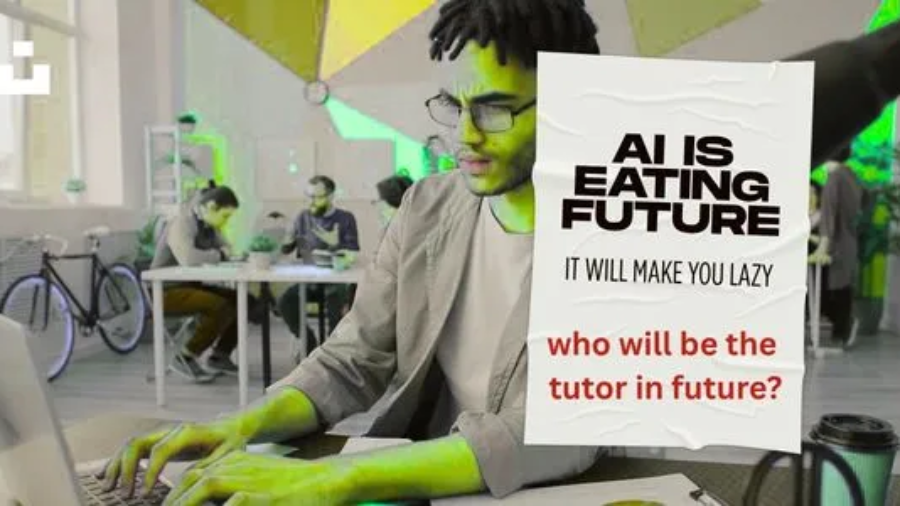
Someone who recently graduated takes their initial employment at a corporation. They start by creating standard reports, organizing data, responding to communications, and assisting superior staff members with routine duties. Although these responsibilities might not appear significant, they educate newcomers how a work environment operates.
Now consider a business that uses artificial intelligence (AI) to finish the majority of this task in a matter of milliseconds.
The business saves time. Workers can concentrate on other elements. However, a different problem that seldom gets sufficient emphasis is how young individuals will acquire the expertise necessary in order to become competent workers if AI does the tasks often assigned to novices.
As businesses integrate AI into their work environments, this issue has grown increasingly crucial. Tharman Shanmugaratnam, the president of Singapore, issued a warning on October 12, 2026, on the potential effects of AI on job prospects for newly graduated students.
His comments were made throughout the World Bank and International Monetary Fund meetings in Bangkok. Concerns were raised not only concerning individuals being replaced by computers but additionally regarding the prospects for young professionals just starting their careers in the workforce.
The Initial Job Is Greater Than Just a Paycheck
The most common topic when discussing AI and labor is deciding computers will eliminate jobs. However, the issue might start considerably earlier, as young individuals find it difficult to acquire their initial chance.
Repetitive tasks are common in starting salaries. A young professional might gather data, write a document’s initial outline, or answer frequently asked inquiries from clients. Many of such tasks are able to be aided by AI tools.
Streamlining these kinds of procedures can help an organization run more quickly and affordably. But these exercises also aid in the learning of novices. They instruct staff members how to locate knowledge, identify errors, interact with coworkers, and accept accountability for their duties.
It takes time for someone to develop into an accomplished expert. Small jobs, errors, constructive criticism, and repetition all contribute to the development of expertise. Young staff members may lose a crucial path to their desired occupations if employers cut back on entry-level positions before providing alternative learning opportunities.
So, the question is not just if AI will substitute for employment. It is if chances for those without expertise will still be available in the job.
The Findings of the Study
In June 2026, a World Economic Forum research looked to see how AI is affecting job openings. It discovered more than one-third of young individuals globally are employed in jobs where they are exposed to medium to elevated levels of artificial intelligence-driven work modifications.
This is not an indication that one out of every three young professionals will experience job loss. Vulnerability indicates that certain aspects of their tasks may be altered by AI. In certain situations, automation might help employees as opposed to taking the place of them.
The difficulty was additionally emphasized by the International Monetary Fund, which Young people have a greater likelihood to be focused in particular professions where activities could potentially be mechanized and in areas in which AI may provide fewer benefits, according to its January 2026 study on Intelligence and jobs.
The difficulty was additionally emphasized by the International Monetary Fund. Young professionals are more inclined to be focused in particular professions wherein jobs may be mechanized as well as where AI may provide less assistance to human labor, according to its January 2026 research on AI and labor.
These results suggest an issue that extends past loss of employment. Organizations and colleges and universities will have to rethink how young individuals become prepared to enter the workforce if the responsibilities which assist novices grow their competencies alter.
The Experience Gap May Grow Into a Serious Issue
Let’s say two newly graduated students compete for a comparable position. Despite having a degree, the individual lacks real-world experience. The second tier has previously completed typical tasks, dealt with actual issues, and gained knowledge of responsible AI use of tools.
The subsequent applicant might possess an edge regardless of whether their educational qualifications are comparable.
This is the point at which the task becomes challenging. Individuals who are capable of working independently, resolve issues, and adjust rapidly are frequently sought after by organizations. However, these skills are typically acquired via experience.
Young individuals might discover themselves trapped in a challenging loop if employers require newly graduated students to have these competencies while providing less opportunity to acquire them.
They require employment to get work experience, though they additionally require expertise to find a career.
If companies digitize everyday tasks without reviewing how lower-level employees are educated, AI might make this issue more apparent. This result cannot be considered unavoidable, though.
Businesses may rethink job openings so that beginners devote more time acquiring knowledge, verifying knowledge, and resolving issues rather than doing routine responsibilities.
The extent to which corporations are going to make that attempt is the true issue.
Acquiring AI Knowledge Is Not the Complete Solution
In order to stay highly competitive, learners are frequently advised to master AI techniques. Although this recommendation is helpful, it is not an absolute solution.
Understanding the way to use AI to create a document is not exactly the same as understanding if the report itself is correct. Knowing which knowledge is important and why is not the same as utilizing a technology to get data.
Thinking critically, communication, inventiveness, and decision-making skills are still essential for young employees. They additionally want chances to use their abilities in practical settings.
Universities can support students by providing standard projects that mirror the needs of the profession, regular responsibilities, and internships. Companies can design instructional materials that let new hires use AI while picking the brains of experienced staff members.
Businesses ought to take into account whether they are actually eliminating the jobs that newcomers utilized to get into the field or minimizing repetitive tasks in a way that supports their professional development.
The question is not simply whether AI can do a beginner’s job. It is whether we are prepared to change the way beginners learn.
Who Will Educate Tomorrow’s Workers?
AI has the potential to increase productivity and open up new commercial prospects. It is unreasonable to think of businesses to disregard innovation that makes their operations more productive. However, production shouldn’t be the only indicator of advancement.
Highly qualified people will continue to be needed by organizations to oversee groups, understand clients, verify outcomes, and arrive at tough choices. It takes time and instruction to cultivate such employees.
Companies, universities, and authorities will have to come up with different methods for young individuals to obtain expertise if the starting points of a profession vanish. If not, businesses might reap the rewards of technology before the following age of employees do.
AI’s ability to perform a simple task does not constitute the only problem. It is whether we are ready to alter how beginners learn.
Anyone needs to develop a different path for young individuals to follow if AI replaces the initial stage of pursuing a career.
Frequently Asked Questions (FAQs)
-
What impact is AI having on beginner-level positions?
Tasks like creating reports, organizing data, and responding to frequently asked inquiries can be automated by Artificial Intelligence. While AI may also lead to the creation of new positions, it could also change the duties of new staff members and limit some employment options.
-
What worries newly graduated students about AI?
In order to obtain real-world experience, fresh graduates frequently rely on their first jobs. Young individuals might discover it more difficult to acquire the abilities required for future employment if companies digitize the basic duties typically assigned to novices.
-
What competencies should learners acquire in order to be ready for employment opportunities driven by AI?
Thinking critically, interaction, imagination, and ability to solve problems should all be developed in learners. It’s crucial to understand how to utilize Artificial Intelligence applications properly in addition to obtaining real-world experience via internships and projects.
If you have liked this Read my other blogs also
Connect with us on other Social Media Channel
YouTube: Click Here
Facebook: Click Here
Instagram: Click Here
LinkedIn: Click Here
Read my travel blogs at click here